
SCOps acts as a personal mission-support tool that helps you, your party, and your entire organization coordinate more effectively while playing Star Citizen. By securely sharing your game data with your leadership team, you ensure everyone is on the same page during operations.
Data Collected and Used
To provide real-time coordination and organizational intelligence, SCOps securely transmits the following data from your game logs to the server:
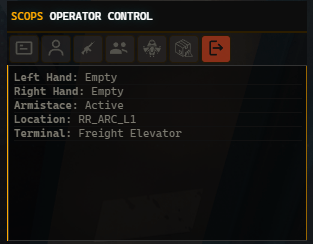
- Player Status & Location: Includes login events, current in-game location, and your status (e.g., Active, Incapacitated, or Online/Offline).
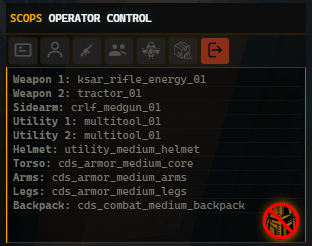
- Equipment & Inventory: Tracks your current loadout, including armor, weapons, and backpack contents, as well as interactions with freight elevators and inventory terminals.
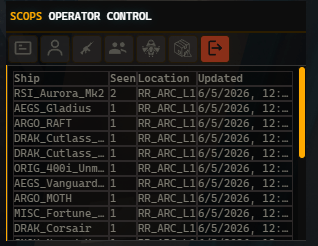
- Vehicle & Navigation Data: Monitors your current ship, vehicle sightings, transit status (in-transit or arrived), and destination points.
- Organizational & Party Details: Captures party member status, join/leave events, current party leader, and proximity alerts when other ships join your channel.
- Terminal Interactions: Records usage of shops, ASOP terminals, and movement through armistice zones.
What SCOps Does for You
- Real-Time Coordination: Your party leader can see exactly where you are and what your status is during group operations, which helps them make faster, better-informed decisions.
- Operational Readiness: The app keeps track of your equipment, ship status, and location automatically, so you don’t have to manually report your status to your leader.
- Safety and Navigation: It monitors your proximity to other ships and whether you are in an armistice zone, helping you stay aware of your surroundings during tense moments.
How SCOps Helps Your Organization
- Better Management: Leadership can monitor the entire organization or specific parties in real-time, making it much easier to organize group activities without having to ask everyone for status updates.
- Community Intelligence: The data helps identify the most popular ships, weapons, and gear across the entire organization, which helps everyone stay up-to-date on what is working best in the current game environment.
Get Involved
SCOps is currently in a closed alpha state. If you are interested in using this tool to support your operations and your organization, please contact us for access.
Development Status: Client/Server Telemetry Engine Update
Our persistent tracking overlay and background system network are fully operational. Below is a breakdown of the external feeds streaming directly to your client cockpit HUD, along with a look at how telemetry data is partitioned between real-time operational command and long-term statistic tracking.
⚠️ DEVELOPMENT NOTICE: Please note that the Command Interface is still actively under development. Additionally, the Client Interface itself is undergoing continuous refinement, meaning further data metrics may be added to it as features expand.
Data Streamed From the Server (To Your Cockpit Overlay)
- Live Market Feed Updates (via UEX Corp Data): Pushes price shifts, commodity supply availability, shortages, and demand spikes directly to the client interface.
- Spatial Anomaly Alerts (via RSI Monitor): Live monitoring loops tracking system infrastructure status, displayed directly as space status updates.
- Note on “SPATIAL ANOMALY” logs: These specific entries appearing in your logs are the rephrasing of active incidents on the RSI Status page.
Data Transmitted To the Server (From Your Client)
To provide utility during live events, your client app packages data into specific telemetry groups. No other personal client data is processed.
Here is exactly how that data is utilized for live operations versus historical analytics:
1. Pilot Identity & Safety Status
- Data Packaged:
name,armistace - Real-Time Command Usage: Flags when a pilot enters or leaves weapons-locked zones, allowing operations leads to update rules of engagement.
- Long-Term Statistic Tracking: Logs session data to track individual engagement metrics and validate active duty roster hours.
2. Pilot Combat Readiness & Loadout
- Data Packaged:
helmet,leftHand,rightHand,equipment - Real-Time Command Usage: Generates a live safety checklist for the Operations Commander to verify that personnel are armed, armored, and have helmets attached before deployment.
- Long-Term Statistic Tracking: Aggregates loadout equipment preferences across the organization to monitor resource trends and hardware deployment choices.
3. Strategic Fleet Positioning
- Data Packaged:
location,atTerminal,playerShips - Real-Time Command Usage: Maps active pilot locations and current terminal tasking (such as retrieving vessels or querying market interfaces) to give leadership situational awareness of where assets are distributed across the map.
- Long-Term Statistic Tracking: Compiles historical sector density heatmaps to identify high-traffic operation zones and logistical dispatch patterns.
4. Shared Supply Statistics
- Data Packaged:
storageCount,inventoryCounts - Real-Time Command Usage: Pushes baseline volume metrics to the command dashboard so logistics leads can see if a warehouse area is nearing capacity.
- Long-Term Statistic Tracking: Audits commodity volume accumulations over time across organizational cargo hubs, providing performance analytics on resource collection without ever reading detailed personal manifests.
5. Real-Time Fleet Roster Sync
- Data Packaged:
members(Nested insidepartyData) - Real-Time Command Usage: Drives the commander’s tactical squad grid overlay, showing live team sizes and displaying alerts if a team member experiences connection loss.
- Long-Term Statistic Tracking: Stores group cohesion metadata to evaluate overall team attendance sizes and analyze historical communication reliability.
6. Collaborative Operation Directives
- Data Packaged:
operationData - Real-Time Command Usage: Synchronizes live contract objectives, current fleet flight manifests, and target assignments across the entire squadron simultaneously.
- Long-Term Statistic Tracking: Records overall operation completion ratios, milestone timelines, and contract tracking histories to evaluate structural campaign efficiency.
7. Tactical Scanning Statistics
- Data Packaged:
seenVehicles - Real-Time Command Usage: None / Not Reported
- Long-Term Statistic Tracking: Aggregates overall hull encounter tallies to generate long-term traffic volume charts, system density mappings, and generic contact frequency reports across the organization.